
Guide to Mobility Scooters
When Mobility Loss Quietly Changes Daily Life
A mobility scooter is a battery-powered device designed for individuals who can still stand or walk short distances but experience fatigue, instability, or pain when covering longer distances.
Mobility changes often do not happen overnight—they accumulate gradually.
In my mother’s case, her mobility has declined over several years. Activities that once seemed ordinary—walking through the neighborhood, shopping at the grocery store, attending outdoor festivals, or visiting museums—have become physically exhausting or, in some cases, no longer possible. Even simple tasks like walking to the mailbox or taking the trash to the curb now require more effort and planning.
As mobility decreases, distance and fatigue begin to influence everyday decisions. Outings require more preparation, recovery time becomes a consideration, and activities may slowly be reduced—not because interest disappears, but because physical limitations become the barrier.
For my mother, this is her current reality. She still wants to participate in the activities she enjoys; the challenge is not motivation—it is mobility.
To understand how these gradual changes affect independence more broadly, see our overview of Overcoming Mobility Challenges at Home.
In this Guide
It matters not how long we live but how. - Philip James Bailey
When to Get a Mobility Scooter
A mobility scooter may be appropriate when walking is still possible—but no longer dependable enough for daily activities.
Common signs include:
Short walks causing fatigue or pain
Avoiding errands due to distance
Skipping social or family outings
Difficulty completing grocery store visits
Increasing fear of falling or instability
A Mobility Scooter That Fits Your Lifestyle
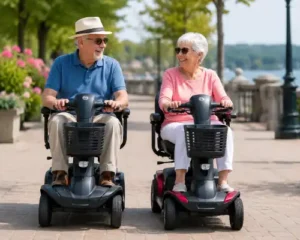
When walking becomes more difficult, it does not mean giving up the activities that bring joy and independence. A mobility scooter can help make everyday experiences possible again—whether that means shopping, visiting family and friends, exploring museums, attending outdoor events, or simply enjoying a trip around the neighborhood.
Today’s mobility scooters are designed for a wide range of needs and lifestyles. Some models are lightweight and foldable for easy transportation, while others provide greater comfort, longer range, or higher weight capacity for more extensive use.
Understanding the differences between scooter types, features, and intended uses can help you choose a mobility solution that supports confidence, independence, and quality of life.
Key Features to Consider
Weight Capacity
Always exceed user weight for safety and performance stability.
Range
Real-world range is typically 70–80% of manufacturer claims.
Speed
Most scooters range from 4–8 mph.
Ground Clearance
Critical for curbs and uneven sidewalks.
Turning Radius
Determines indoor usability in stores and tight spaces.
Comfort Features
- Adjustable seat and armrests
- Proper cushioning for long use
- Suspension systems
- Adequate legroom
Battery Types
Sealed Lead Acid (SLA)
- Lower cost
- Heavier
- 8–12 hour charge time
Lithium-Ion
- Lighter weight
- 3–5 hour charge time
- Longer lifespan
- Higher upfront cost
NOTE: Environmental and Usage Impacts
- Cold weather reduces range
- Terrain and user weight reduce battery life
Medicare Coverage for Mobility Scooters
Mobility scooters may be covered under Medicare Part B as durable medical equipment (DME) if requirements are met.
Requirements:
- Physician documentation
- Proof of in-home mobility limitation
- Purchase through approved supplier
Important limitation:
Medicare coverage is generally tied to in-home mobility, not outdoor independence or lifestyle use.
Types of Mobility Scooters
Travel Mobility Scooters
Best for: errands, short trips, transport needs
- Lightweight, disassembles for car storage
- Range: 8–15 miles
- Easy to transport
- Less comfort for long use
Full-Size Mobility Scooters
Best for: daily independence and outdoor use.
- Larger seats and stronger suspension
- Range: 15–25 miles
- High stability and comfort
- Requires vehicle lift or ramp
Folding Mobility Scooters
Best for: travel + storage convenience
- One-step folding design
- Compact storage footprint
- Airline-friendly models available
- Shorter range and lower capacity
Heavy-Duty Mobility Scooters
Best for: higher support and durability needs
- 400–500+ lb weight capacity
- Reinforced frame and motors
- Wider seating and stability
- Less portable
All-Terrain Mobility Scooters
Best for: outdoor environments and uneven surfaces
- Large pneumatic tires
- High ground clearance
- Suspension systems
- Designed for parks, gravel, and trails
3-Wheel or 4-Wheel Scooters
3-Wheel Scooters
Best for: indoor use
- Better maneuverability indoors
- Not much room for a foot rest
- Smaller turning radius
- Less stable outdoors
4-Wheel Scooters
Best for: outdoor use
- Greater stability on sidewalks and slopes
- Safer for outdoor use
- Preferred for uneven terrain
Best Mobility Scooter Recommendations
Based on the key differences in portability, comfort, and terrain needs, we’ve identified the top mobility scooters for different lifestyles. The next guide compares our recommended models with pros and cons of each.